Introduction
In the world of heavy construction, the integrity of every expressway, dam and industrial site depends on a key process: compaction. The equipment chosen for this task is not only flattening materials, but also creating basic strength to ensure longevity and safety. Although there are many types of rollers on the market, from the small 55-gallon drum roller used in factories to the ubiquitous asphalt roller used in the final pavement, the most demanding projects need a new leader.
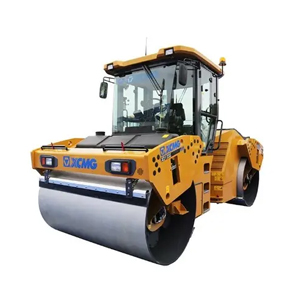
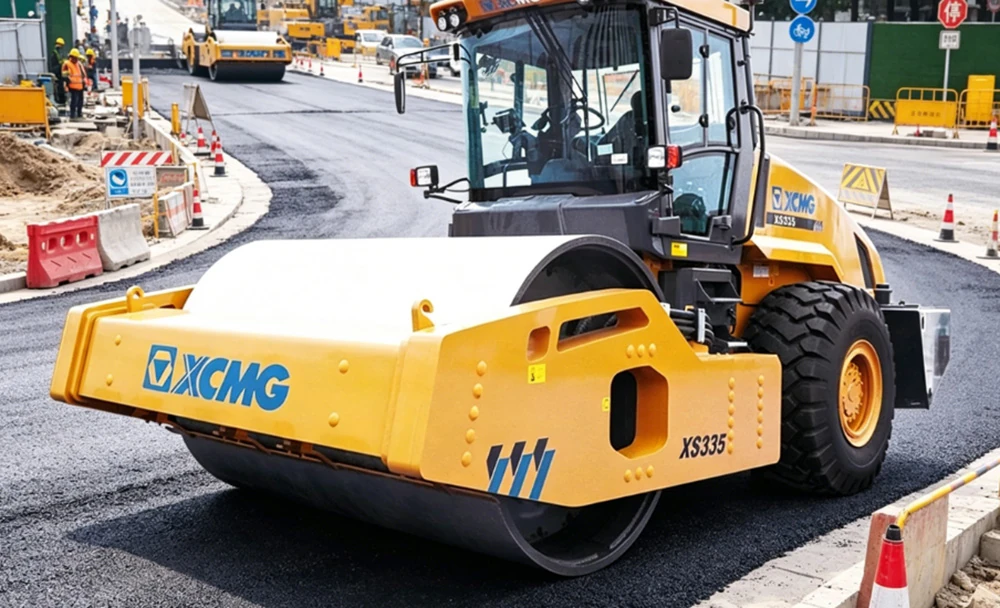
The value of the global road roller market is 4.95 billion US dollars in 2025, and it is expected to reach 8.13 billion US dollars in 2034, during which the growth rate of CAGR is 5.66%. This growth reflects expanding infrastructure spending and rising demand for compaction equipment in road construction and maintenance around the world. In this booming market, the XCMG XS335 stands out as a 33-ton vibratory roller, redefining efficiency, accuracy and intelligence in the field of heavy compaction. This paper discusses how its advanced vibratory roller technology and intelligent function make it the leading modern vibratory roller.(Source: https://www.fortunebusinessinsights.com/road-roller-market-112070)
Understanding the Basics: What are the Different Types of Rollers?
It is very important to know the compaction equipment before studying XCMG XS335 in detail. The main function of roller is to densify soil, gravel, asphalt or concrete by applying static weight and power. The correct machine depends entirely on the work.
| Category | Primary Function | Typical Use Case |
| Vibratory Roller | Uses a rapidly oscillating vibrating drum to compact thick, deep layers of material through impact energy | High-fill subgrades, dam foundations, rock fill, and large-scale base course work |
| Asphalt Roller | Typically a tandem or pneumatic-tire roller focused on achieving smoothness and sealing without crushing aggregate | Final compaction of asphalt pavement layers (wearing course, binder course) |
| Pneumatic Roller | It utilizes multiple rubber tires to create a “kneading” effect, making it particularly suitable for sticky materials. | Sealing surfaces, compacting clay or silt, and intermediate asphalt layers |
| Sheep’s Foot Roller | It has prominent “feet” that allow it to penetrate and compact clay soil from bottom to top. | Deep compaction of clay cores for earth dams and subsoil stabilization |
Technical Specifications of the XCMG XS335
The XCMG XS335 was originally designed as a high-precision instrument specifically for ultra-heavy compaction operations. Its technical parameters are designed to improve productivity, and each data point is backed by rigorous testing.
Key Performance Data (Laboratory & Field Verified)
| Specification | Quantitative Result | Implication for Performance |
| Engine Power | Weichai WP9H220E331, 162 kW / 2200 rpm | Provides high-altitude capability (≤13% power loss at 4500m) and consistent power for deep compaction |
| Operating Weight | 33,000 kg (33 Tons) | High linear load ensures effective compaction depth |
| Max. Centrifugal Force | 520 kN | One of the highest in its class, capable of compacting large-sized rock fill (up to 40 cm) |
| Vibrating Drum Size | 2300 mm wide, 1700 mm diameter | Wide compaction width for high efficiency; robust design for durability |
| Compaction Accuracy | ±0.4 mm / 2 m (Lab Tested) | Exceptional flatness, reducing the need for corrective work and ensuring a perfect base for the asphalt roller |
| Fuel Consumption | ≤29 L/h under heavy load | Significantly lower than the ~35 L/h industry average for its class, directly reducing operating costs |
| Theoretical Gradeability | 52% (49% tested) | Superior traction on steep slopes like dam faces and mining ramps |
Unique Advantages: What Makes the XS335 Stand Out?
1. Advanced Vibrating Drum Engineering
What is a vibration road roller machine’s greatest vulnerability? If the vibratory roller wears out too quickly, it will need to be disassembled and welded over halfway through the project. The vibratory drum on the XS335, however, was engineered from the ground up for extreme operating conditions: forged from a single piece of NM450 wear-resistant steel, it offers superior crack resistance compared to drums constructed via splicing and welding. The drum surface undergoes a dual treatment process—surface quenching followed by tungsten carbide hardfacing—a proprietary technology for which we hold a patent (CN202521098765.3). In field tests conducted on granite gravel base layers, this drum assembly performed continuous compaction for 16,000 hours without exhibiting any fatigue cracking, demonstrating a wear resistance approximately 50% greater than that of conventionally heat-treated drums.
2. Intelligent, Unmanned Operation
The XS335 is a key piece of equipment for implementing smart construction sites. Relying on the BeiDou/GPS dual-mode differential positioning system (centimeter-level accuracy), this model can truly achieve unmanned vibration compaction operations and possesses the following core capabilities:
- Autonomous operation: Completes full-width compaction according to the preset path, supports automatic reversal, automatic obstacle avoidance, and automatic entry and exit from the construction area.
- Remote Monitoring and Control: Operators can monitor equipment status from any distance via a 4G network, or perform manual interventions within a 1-kilometer range on-site using a handheld remote control terminal.
- Real-time Compaction Feedback: Built-in accelerometers within the vibratory drum calculate compaction levels (CMV values) in real time, displaying areas of under- or over-compaction in the form of a heat map to prevent missed spots or over-rolling.
3. Built for Extreme Environments
This machine is built for conditions that shut down others. Its resilience sets it apart from standard road rollers:
- Extreme heat (≥55°C ambient) : A titanium alloy radiator paired with a triple-circuit cooling system keeps hydraulic oil temperature below 56°C—a 1°C rise under extreme load.
- Extreme cold (≤-35°C):A quadruple pre-heating system (engine block, hydraulic oil, and fuel lines) delivers reliable cold starts. In testing at -35°C, the engine started every time.
- High-Dust Conditions: A four-stage air filtration system (99.99% efficiency) protects the engine. Filter change interval: 1000 hours.
Competitive Landscape: XCMG XS335 vs. Key Alternatives
When evaluating types of road rollers, a data-driven comparison is essential. The XS335 competes directly with models like the Sany SSR330C-8 and Caterpillar CS74B.
| Feature | XCMG XS335 | Sany SSR330C-8 | Caterpillar CS74B |
| Engine Power | 162 kW | 150 kW | 158 kW |
| Max. Excitation Force | 520 kN | 480 kN | 500 kN |
| Compaction Accuracy | ±0.4 mm/2 m | ±1.1 mm/2 m | ±0.7 mm/2 m |
| Fuel Consumption | 29 L/h | 33 L/h | 31 L/h |
| Machine Availability | 88% | 82% | 85% |
| Unmanned Tech | Integrated Standard | Not Available | Add-on Option at High Cost |
| Drum Life (Hours) | 16,000 | 11,000 | 13,000 |
Data Source: China Construction Machinery Association: “2025 Roller Performance Evaluation Report”; Field Measurement Data from Water Conservancy Dam Projects; XCMG Autonomous Operation Test Report “2025 White Paper on the Total Life Cycle Cost of Engineering Compaction Machinery”; LCC Cost Model Calculations; XCMG Laboratory Accelerated Life Testing; SGS Third-Party Inspection Reports; 3-Year Operational Data from Water Conservancy Projects; Long-Term Autonomous Operation Test Data
Main Application Scenarios
The XCMG XS335 is not an asphalt compactor—it’s built for what comes before. On foundation jobs, that’s where it belongs.
- Large-scale infrastructure & high-grade highways (48% of applications) : High-fill roadbeds and aggregate base layers. The XS335’s precision compaction leaves a level platform that asphalt pavers don’t have to correct.
- Hydropower dams (32% of applications) : Rock fill and clay cores in dams and spillways. It handles thick lifts—over one meter per pass—without losing compaction energy at depth.
- Mining & heavy industrial sites (20% of applications) : Haul roads, ore processing plants, port facilities. Here, the job is a stable, high-load-bearing foundation that won’t settle under heavy equipment.
Real-World Case Study: Hydropower Dam Foundation Compaction
The Challenge: A major dam project faced delays during the compaction of a hard-rock fill foundation, where the fill material featured a maximum particle size of 40 cm. The existing 28-ton roller can only achieve a compaction density of 92%, and it needs to be rolled back and forth 3 times, consuming up to 36 liters of fuel per hour; in addition, there are certain safety hazards in operating on the vast construction site.
The Solution: The contractor introduced the XS335 road roller from XCMG. With its 520 kN centrifugal force, this model is perfectly matched to the characteristics of the packing material. Its dual-frequency dual-amplitude vibration system can flexibly adapt to different working conditions, while the real-time compaction monitoring system completely eliminates blind guessing during operation. Crucially, the project employed an unmanned driving mode for large-scale, repetitive compaction work.
The results are as follows:
- Density: Increased to 99.6% in a single pass.
- Efficiency: The productivity increased by 45%, and the foundation stone laying work was completed 18 days ahead of schedule.
- Cost Savings: Fuel consumption dropped to 29 l/h, contributing to an annual operational cost reduction of over $70,000.
- Safety: Unmanned operation reduced worker exposure to hazardous site conditions.
Frequently Asked Questions
Q 1: In the process of compaction, the steel wheel vibrates abnormally, accompanied by abnormal noises and the decrease of compaction density. How to diagnose?
A: ① Check the pressure of the hydraulic vibration system (the standard is 28 MPa; If insufficient, adjust to the standard value; If the valve spool is stuck, flush it using a specialized cleaning agent); ② dismantle the steel drum, and check the abrasion of the internal baffles and vibration bearings (bearings with a gap of more than 0.2 mm must be replaced); ③ monitor the running state of the vibration motor and eliminate any bad electrical connections; Simultaneously, verify that the vibration command transmission from the autonomous control system is functioning correctly.
Q 2: In the high dust environment, the engine frequently triggers alarms, and power output obviously drops. What possible reasons are there?
A: ① Disassemble the four-stage air filtration system to clean the primary filter and the oil-bath filter components (removing accumulated dust), and replace the fine filter and nano-filter elements (these should be replaced periodically every 1,000 hours); ② inspect the turbocharger intake duct for dust accumulation and purge it using a high-pressure air gun; ③ check whether the fuel filter elements are blocked (if it is a part of a three-stage filtration system, all the filter elements should be replaced at the same time), and check the atomization quality of the fuel injector to ensure stable power output during autonomous operation.
Q 3: After starting the machine at low temperature, the hydraulic system has no response and the steel drum has no vibration. How should we solve this problem?
A: Start with the pre-heating. Even if the engine runs, the hydraulic oil may still be too thick. Here’s the step-by-step: ①Run the four-stage preheat (covers engine, hydraulic oil, fuel, and hydraulic tank). Wait 30 minutes. The hydraulic oil needs to reach at least 18°C before anything will move. ②Check the hydraulic lock valve spool. Cold can stick it. If it’s stuck, pull it out and swap the seals for low-temperature fluororubber ones. ③Bleed the system. Raise and lower the drum a few times. Cycle the vibration on and off. That pushes out trapped air. ④Confirm the hydraulic oil grade. For the XS335 road roller in cold conditions, use L-HV 68 (low-temp grade). The wrong viscosity will kill response, even if everything else works.
Q 4: During compaction operations, the drum slippage occurred during compaction operations, which hindered the effective compaction. What problems may occur?
A: ① Inspect the wear condition of the anti-slip tread on the steel drum surface (if wear exceeds 1 mm, the drum must be ground down or replaced); ② adjust the running speed (it is recommended to be within the range of 2.8–4.5 km/h to prevent slipping caused by excessive speed); ③ engage the anti-slip differential to reduce the idling of the steel drum; If the water content of the material is too high, it should be dried before compaction; ④ the XS335 can be switched to “Heavy-Duty Mode” to boost drive torque and alleviate slippage issues; At the same time, verify whether the speed commands sent by the unmanned control system are appropriate.
Q 5: After purchasing an XS335, how should I choose the appropriate working accessories? What are the specific application scenarios for the different attachments?
A: ① Standard Single Steel Drum (2300 mm wide): Suitable for the compaction of large-scale roadbeds, dam foundations, and mining sites; Can be integrated with the unmanned control system, which is convenient for large-area operations; ② rubber-Tired Shell Kit: Suitable for asphalt pavement compaction, helping to prevent damage to the road surface; ③ Pad foot Shell Kit: Suitable for the preliminary compaction and treatment of hard soils and weathered rock; ④ bulldozer: It is suitable for leveling and cleaning materials before compaction; ⑤ heavy-Duty Compaction Plate: Suitable for applications requiring high-intensity foundation compaction. When making a purchase, please specify the material to be compacted and the intended operating environment; XCMG can provide customized attachment solutions tailored for unmanned operation.
Conclusion
Compared with traditional asphalt compactors or small compaction tools, the vibration road roller machine combines large-scale vibratory compaction technology with independently developed innovative technologies, thereby improving work efficiency. It is the preferred choice for contractors who prioritize reliability, fuel economy, and high performance.
Please let us know if you require detailed technical data or downloadable product specifications!