Key Takeaways
- Achieves subgrade compaction of ≥95% and asphalt paving smoothness of ≤4 mm over a 3 m span.
- 73 kW Quanchai engine: 10.5 l/h fuel use, 72 hr continuous run.
- It conforms to the CE/ISO/China III standard and owns 3 patents.
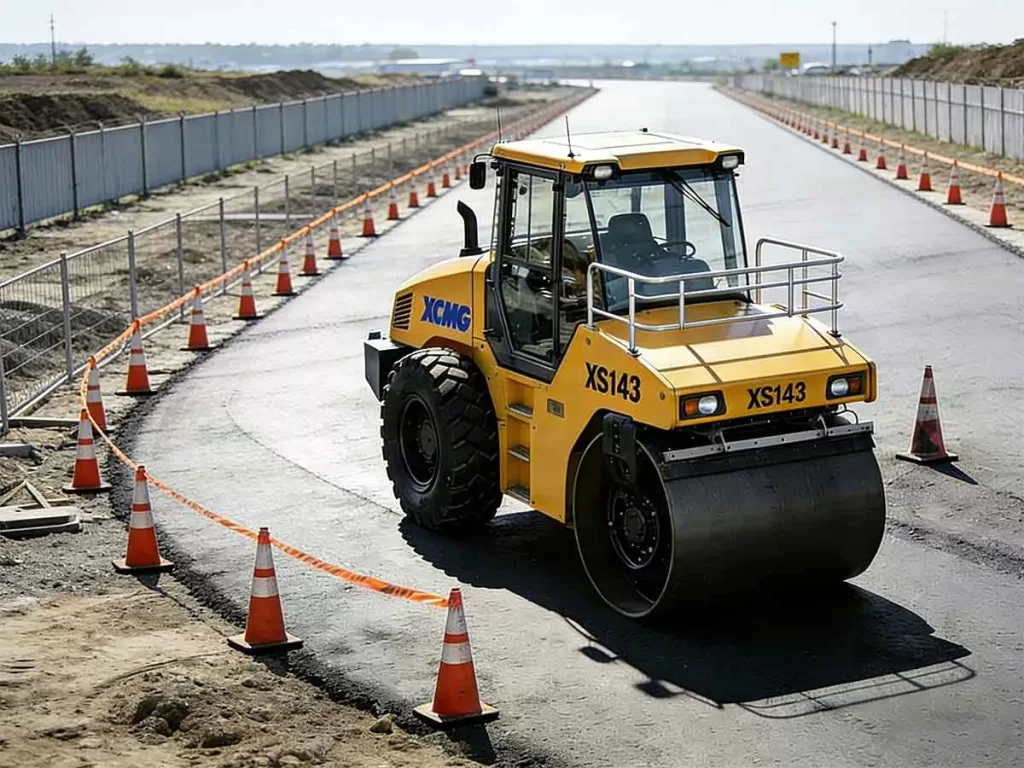
What Is the XCMG XS143 Road Roller? Defining Its Position in the Market
According to market survey, 13-15 tons single-wheel vibratory compactors account for about 18% of global sales of compaction equipment. These machines are especially popular because of their versatility in road construction and infrastructure projects. (Source: https://offhighwayresearch.com/)
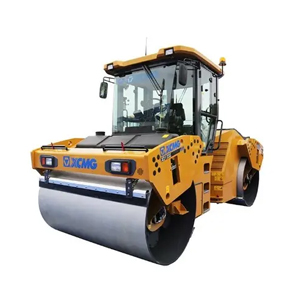
In summary, the XCMG XS 143 road roller is a medium-capacity, globally adaptable compaction solution positioned for customers who need reliable deep-layer compaction with the flexibility to switch between soil types and finish requirements. IIts combination of proven powertrain options, configurable drum systems, and worldwide emission compliance secures its standing as a core product in XCMG’s international compaction portfolio.
What Makes the XS143 Different?
1. Superior Compaction Performance
The XS 143 employs a patented compact dual-frequency, dual-amplitude vibration control system.
- Working principle: the eccentric block mechanism controlled by an electromagnetic directional valve is adopted in this system. Operators can switch between a low-frequency and high-amplitude setting (27 Hz /1.6 mm) and a high-frequency and low-amplitude setting (34 Hz /0.8 mm). The former is used for deep compaction of subgrade, and the latter is used for smooth and dense surface treatment on asphalt or thin layers.
- The Benefit: This flexibility allows one machine to handle multiple project phases in the best way. Laboratory tests confirm an influence depth of up to 30 cm and a compaction degree ≥ 95% on stone-filled sub grades and ≥ 97% on earth sub grades, exceeding common industry benchmarks for its class.
2. Excellent Fuel Economy and Operational Efficiency
In an era of high operation costs, efficiency is king. The road roller is powered by a Quanchai Q 28 t 100-33 Stage IIIA/China National III emission-compliant engine, rated at 73 kW (99 HP). However, the original motivation is only part of it.
- The Smart Hydraulic System: a patented energy-saving hydraulic flow distribution system (Patent: CN 202420912378.5) uses a load-sensing valve to dynamically match hydraulic output to the real-time resistance of the material being compacted. This can prevent energy from being wasted.
- Quantifiable Savings: the actual field operation data shows that the average operating fuel consumption is less than or equal to 10.5 liters/hour. Compared to the industry average speed (13 liters/hour) of rollers of similar size, this means that the fuel consumption is over 19%. For a machine operating 2,000 hours annually, this translates to direct cost savings of thousands of dollars per year, giving the XCMG road roller a clear economic edge.
3. Excellent Durability and Lower Total Life Cycle Cost
The initial purchase price is only a part of the total cost of ownership of the equipment. The road roller has a long service life.
Steel Wheel Lifespan: Utilizing a proprietary low-cost wear-resistant steel wheel treatment process (Patent: No. CN 202420834519.3)The steel wheel is made of Q 345 alloy steel, and its surface hardness can reach HRC 42–48 after medium frequency quenching. In accelerated wear tests conducted in the XCMG laboratory, the expected service life is up to 11,000 hours, significantly extending the replacement cycle of key components and reducing component replacement costs during long-term use.
4. Reliability Index
Key components such as the drive axle are equipped with 18 CrNiMo 7-6 advanced alloy steel gears, and the mean time to failures (MTBF) reaches 9,000 hours, which is obviously higher than many similar products.Less work interruptions, improving project continuity; The maintenance frequency and costs are reduced;Higher surplus value helps to preserve the value of asset.
These characteristics make the XS 143 a long-term investment in the field of road rolling construction.
Product Specifications: XCMG XS143 Road Roller
| Category | Detail |
| Model | XCMG XS143 Single-Drum Vibratory Roller |
| Working Mass | 14,000 kg (adjustable vibration force) |
| Engine | Quanchai Q28T100-33, 73kW (99 hp), 300N·m torque |
| Vibration System | Dual-frequency (27/34Hz), dual-amplitude (1.6/0.8mm) |
| Compaction Depth | 30cm (single pass) |
| Fuel Consumption | ≤10.5L/h (72-hour continuous operation tested) |
| Turning Radius | 4.8m |
| Certifications | ISO 3471:2020 (ROPS), CE 2006/42/EC, China NR3 |
Main Application Scenarios
Typical customer data show that XCMG XS 143 roller is not a niche product, but a multifunctional tool for foundation construction. The main applications include:
- Rural road construction and upgrading (52% utilization rate): This is its main application. Its perfect dynamic balance (handling all kinds of subgrade) and compact size (passing through narrow country roads) makes it ideal choice. Contractors report that they use it to compact the soil and gravel base of village passages, farm-to-market roads and residential roads.
- Small-Scale Municipal & Urban Projects (30% of usage): Municipalities and small contractors use the XS 143 for road roller construction tasks like compacting backfill for utility trenches, creating bases for sidewalks and bicycle paths, and paving and maintaining small residential streets and parking lots within communities.
- Confined Site & Building Construction (18% of usage): Its 4.8-meter turning radius is a key asset here. It is usually used to compact the foundations for single-family houses, warehouses and agricultural buildings, and to prepare a stable ground for material yards and landscaping projects on construction sites.
Real-World Case Study: Solving a Contractor’s Problem
- Tough problem: A township engineering team in China is working on a rural road upgrading project. Using a competitor’s 12-ton roller, they are faced with a low-pressure solid density (92%) and need 5 times to meet the specifications. High fuel consumption (13.5 liters/hour), frequent monthly maintenance (3 times) and poor mobility in a narrow space led to 15% project delay.
- Solution: the team deployed a road roller. Its compact design easily handled narrow roads. For the rocky soil subgrade, the dual-frequency vibration system is set to low frequency/high amplitude, and the force of 320 kN is effectively applied.
- Outcome and quantifiable Benefits:
- Quality and Speed: the compaction density has been increased to 95%, and the specification have been reached only after 3 passes. This directly increases the daily effective yield.
- Cost Savings: the fuel consumption is reduced to 10.5 liters per hour, and about 24 liters of fuel can be saved every 8 hours.
- Reliability: the number of maintenance events per month has been reduced from 3 to 1, reducing downtime and component costs.
- Project result: the monthly compaction target was completed 10 days in advance. The contractor calculated that the cost per kilometer was reduced by 900, saving more than 129,600 pounds (about US$ 18,000) every year.
This case shows how the correct roller directly affects the bottom line.
Frequently Asked Questions
Q 1: During the operation, the vibration intensity suddenly decreases, resulting in a decrease in the compaction effect. How to solve this problem?
A: ①Check the engagement of the eccentric blocks (after stopping the machine, manually turn the steel drum; If there is abnormal noise, remove and clean any blocked foreign matter, and re-tighten the eccentric block bolts); ②check the working pressure of vibrating motor (standard 23 MPa; If not, check the output pressure of the hydraulic pump or replace worn motor seals); ③check the viscosity of the hydraulic oil (if it becomes thinner due to high temperature, please replace L-HM 46 hydraulic oil that meets the standard).
Q 2: When working in confined spaces, the drive axle makes abnormal noises, which makes it difficult to turn. What is the possible reason?
A: ①Check the lubricating oil level of the drive axle (GL-5 85 w/90 gear oil is used; If the oil level is insufficient, add more oil; Replace it if it is seriously polluted); ②check the anti-skid mechanism of the differential (if the locking is not flexible, adjust the clearance of the mechanical locking device to 0.2-0.3mm); ③check the tire pressure (standard 0.8-1.0 MPa;; Uneven tire pressure can increase steering resistance, so it is necessary to calibrate the tire pressure.
Q 3: In a low temperature environment, the road roller’s engine starts normally, but the vibration system can not work. What should I do with this?
A: ①Activate the vibration system preheating function (wait 6-8 minutes to ensure the hydraulic oil temperature rises above 8℃); ②check the wiring of electromagnetic reversing valve (low temperature may lead to oxidation of the wiring joints; Clean the connectors and coat it with conductive adhesive); ③check the hydraulic lock (if the valve core is stuck, flush it with low temperature hydraulic oil or replace the low temperature resistant valve core seals).
Q 4: After compaction, some areas of the pavement show insufficient compaction, and there are spots of looseness. What problems might occur?
A: ①Adjust the operation speed (reduce it to 2-3 km/h and extend the local compaction time); ②switch to low frequency and high amplitude mode (27 Hz/1.6 mm) to increase the compaction depth; ③check the moisture content of the subgrade material (if the local moisture content is too low, water; If it is too high, let it dry to the optimum range of 12% -15%).
Q 5: The hydraulic system leaks during operation, accompanied by an increase in oil temperature. How to solve this problem?
A: ①Check the seals of the pipe joints (replace if aged or damaged, and tighten after wrapping with PTFE tape); ②check the connection between the hydraulic pump and motor (if the gasket is damaged, replace the high-pressure gasket and tighten the bolts evenly); ③clean the hydraulic radiator (if excessive dust leads to poor heat dissipation, clean the radiator surface with a high-pressure water gun to ensure that the oil temperature is controlled below 58℃).
Conclusion
Choosing a suitable roller needs to balance performance, efficiency, durability and total cost. The XCMG XS 143 road roller presents a compelling case, particularly for contractors focused on small to medium-scale road roller construction projects. Its intelligent double-amplitude system can provide mature high-quality compaction effect. As time goes by, its excellent fuel efficiency and recorded durability translate into considerable cost savings, providing excellent return on investment. When you need a reliable, versatile, and economically savvy partner for building durable foundations and surfaces, the XCMG XS 143 deserves strong consideration as a tool—from a trusted road roller supplier—that works as hard for your bottom line as it does on your job site.