Introduction: The Core Equipment Choices in Modern Container Terminals
Why the Right Equipment Selection Directly Impacts Terminal Throughput
Modern container terminals face increasing pressure to improve handling efficiency, reduce operating costs, and maintain reliable cargo flow. As global container transportation continues to expand, terminal operators need equipment that matches their yard layout, cargo volume, and operational requirements. Choosing between a reach stacker, empty container handler, or other terminal machines is a long-term productivity strategy.
According to the International Transport Forum (ITF), global freight transport demand is expected to continue growing significantly in the coming decades, creating higher requirements for efficient logistics infrastructure. In container yards, equipment selection directly affects loading speed, storage density, fuel consumption, and labor efficiency.
A suitable handling solution helps terminals reduce unnecessary container movements and improve daily throughput. For many medium-sized ports, logistics parks, and intermodal terminals, a container reach stacker can balance flexibility and lifting capability because it can move containers, stack them, and support different operational tasks with a single machine.
Different terminal environments require variable equipment characteristics. Large automated ports may prefer highly specialized systems, while flexible terminals often choose mobile machines that can adapt to changing workloads. Understanding the differences between reach stackers and empty container handlers can help procurement managers to make decisions based on actual operating conditions.
What Is a Reach Stacker?
Versatility and Mobility for Mixed Cargo Handling
A reach stacker is a heavy-duty material handling machine designed for lifting, transporting, and stacking intermodal containers. Unlike traditional forklifts, reach stackers use a telescopic boom system that allows operators to access containers positioned behind the first row. This design improves flexibility in container yards where space utilization and operational mobility are important.
The main advantage of a reach stacker is versatility. A single machine can usually handle full containers, empty containers, and different container sizes, including common ISO 20-foot and 40-foot units. This makes it suitable for ports, railway terminals, freight yards, and industrial logistics centers where container flows change frequently.
The XCMG reach stacker XCS4535K is an example of a heavy-duty container handling solution developed for demanding logistics environments. The machine has a maximum lifting capacity of 45 tons and a maximum lifting height of 15,100 mm. Its stacking capability can reach six containers high and three containers deep, helping operators improve yard utilization while maintaining operational flexibility.
Key specifications of XCS4535K include:
| Parameter | Specification |
| Model | XCS4535K |
| Equipment Type | Container Reach Stacker |
| Maximum Lifting Capacity | 45 tons |
| Maximum Lifting Height | 15,100 mm |
| Stacking Capacity | 6 high / 3 deep |
| Applicable Containers | 20ft, 40ft, 45ft ISO containers |
| Wheelbase | 6,500 mm |
| Maximum Travel Speed | 27 km/h |
| Machine Weight | Approximately 76.5 tons |
(Source: XCMG official product information)
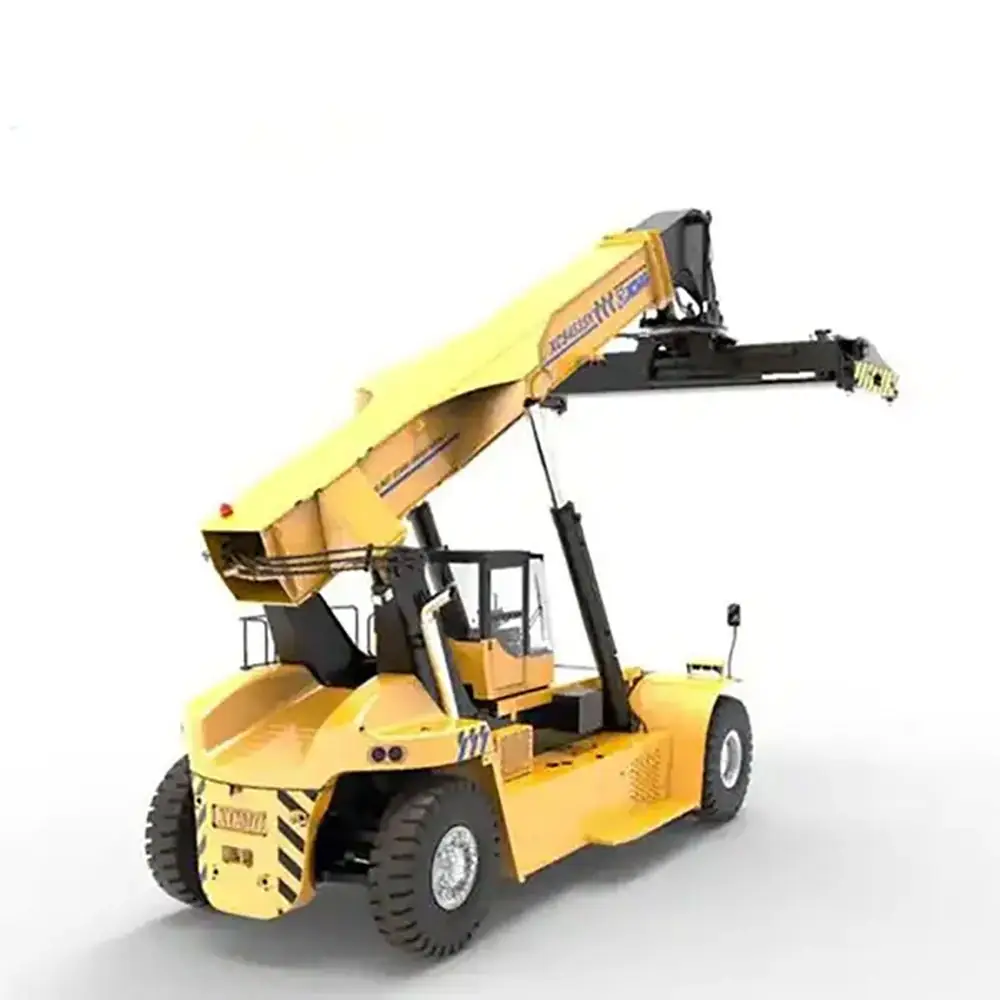
The container reach stacker is especially useful in terminals where container volumes are moderate or where yard layouts frequently change. Compared with fixed handling systems, mobile reach stackers can quickly move between different working zones, which provides additional flexibility during peak seasons or unexpected demand changes.
For example, a logistics park may need to handle import containers in the morning, reposition empty containers in the afternoon, and support railway loading operations later in the day. A versatile reach stacker can complete these tasks without requiring major infrastructure adjustments.
What Is an Empty Container Handler?
Specialized Stacking Power for High-Density Empty Container Yards
An empty container handler is a specialized machine designed mainly for moving and stacking empty containers. Unlike reach stackers that focus on flexible operations, empty container handlers are optimized for high-density storage environments where large numbers of empty containers need to be organized efficiently.
Empty container yards often have different operational priorities compared with general container terminals. Since empty containers usually have lower weight but require large storage capacity, the main challenge is maximizing vertical stacking and reducing yard space requirements.
These machines typically use a front-mounted spreader system to lift empty containers and stack them at greater heights. Their structure allows operators to organize large quantities of empty boxes in dedicated depots, shipping container yards, and maintenance facilities.
The main advantages of empty container handlers include:
- Higher stacking efficiency for empty containers
- Better space utilization in dedicated yards
- Faster repetitive handling operations
- Reduced movement distance inside container depots
However, their specialized design also means they are less flexible than reach stackers when handling mixed cargo operations. A terminal that manages both loaded and empty containers may require additional equipment to cover all operational requirements.
When comparing a Kalmar reach stacker with an empty container handler, the key difference is not simply lifting capacity. The decision depends on whether the terminal prioritizes operational flexibility or maximum empty-container storage density.
When to Choose a Reach Stacker vs. an Empty Container Handler
Choosing the right container handling equipment requires a clear understanding of the terminal’s operational model. Although reach stackers and empty container handlers are both designed for container movement, they serve different purposes. A reach stacker emphasizes flexibility, while an empty container handler focuses on specialized stacking performance.
For procurement managers, the decision should consider several factors, including container volume, yard density, equipment utilization rate, operating environment, and future expansion plans.
A reach stacker is generally suitable for terminals that require multi-purpose handling. It can load and unload containers from trucks, move containers between storage areas, and organize different types of cargo. This flexibility makes it a common choice for medium-sized ports, railway terminals, and logistics centers.
An empty container handler is more suitable for dedicated container depots where large numbers of empty containers need to be stacked in limited spaces. These facilities usually have predictable workflows and require maximum storage density.
The following comparison highlights the differences between these equipment solutions:
| Comparison Factor | Reach Stacker | Empty Container Handler |
| Main Application | Mixed container handling | Empty container storage yards |
| Operation Flexibility | High | Medium |
| Container Types | Loaded and empty containers | Mainly empty containers |
| Mobility | Excellent mobility between working areas | Designed for repetitive yard operations |
| Stacking Efficiency | High | Very high for empty containers |
| Best Suitable Environment | Ports, railway terminals, logistics yards | Empty container depots |
| Investment Consideration | One machine for multiple tasks | Specialized equipment for specific operations |
According to the World Shipping Council, efficient container handling infrastructure plays an important role in improving supply chain reliability and reducing unnecessary port delays. (Source: World Shipping Council)
For many growing terminals, investing in a flexible machine can provide advantages during business expansion. A machine such as the XCMG reach stacker XCS4535K can support different container handling scenarios because of its 45-ton lifting capacity, high stacking capability, and compatibility with multiple ISO container sizes.
Its technical configuration is designed for heavy-duty operations. The machine uses a robust chassis structure, reliable drivetrain components, and a telescopic boom system to support frequent lifting cycles. The combination of mobility and lifting performance allows operators to manage changing workloads without depending on multiple specialized machines.
However, equipment selection should always be based on actual operating requirements. A high-capacity reach stacker may not be the most economical choice for a facility that only stores empty containers. Similarly, an empty container handler may limit flexibility in a terminal that frequently handles loaded containers.
A practical decision process can include the following steps:
Step 1: Analyze Container Flow
Terminal operators should evaluate daily container movements, including:
- Number of containers handled per shift
- Percentage of loaded and empty containers
- Peak season demand changes
- Average transportation distance inside the yard
Understanding traffic patterns helps identify whether flexibility or specialization is more valuable.
Step 2: Evaluate Yard Layout
The physical structure of the terminal also influences equipment selection. Open yards with changing container positions often benefit from mobile equipment. High-density storage areas may require machines designed for repetitive stacking.
Step 3: Consider Total Operating Cost
Purchase price is only one part of the investment decision. Operators should also consider:
- Fuel consumption
- Maintenance requirements
- Operator training
- Spare parts availability
- Equipment utilization rate
A machine with higher flexibility may provide better long-term value if it can replace several types of equipment.
Why XCMG Reach Stackers Are Considered for Terminal Applications
XCMG supplies handling machines for ports, logistics hubs and factories. The XCS4535K reach stacker balances strong lifting power, flexible movement and full container compatibility.
This unit works with all standard ISO containers for these core jobs:
- Loading and unloading containers
- Yard container stacking arrangement
- Rail freight container transfer
- Short-distance container hauling
- Multi-modal cargo transit
It serves yards needing both stable performance and flexible operation. Its 45-ton load capacity lifts heavy containers, and its stacking function maximizes yard space utilization.
Reach stackers do not replace dedicated port machinery. They act as flexible auxiliary gear to boost handling output during peak cargo rushes, suiting yards with irregular container throughput.
Conclusion: Making the Right Investment for Your Terminal’s Future
Choosing between a reach stacker or empty container handler requires a detailed evaluation of terminal requirements. Each machine type has a specific role in modern container logistics, and the best investment depends on factors such as cargo flow, yard structure, operating frequency, and future development plans.
A reach stacker is often preferred by terminals that require operational flexibility. Its ability to handle different container sizes, move between working areas, and support multiple logistics tasks makes it suitable for ports, railway terminals, and industrial yards. The container reach stacker remains a practical solution for operators that need one machine to complete various container handling activities.
An empty container handler provides advantages in dedicated empty container yards where storage density is the primary concern. Its specialized design helps maximize stacking efficiency, especially in locations where large volumes of empty containers must be organized within limited space.
For many medium-sized terminals and logistics operators, the priority is achieving a balance between productivity, flexibility, and investment efficiency. Equipment such as the XCS4535K reach stacker shows how modern handling machines can support complex container operations through strong lifting capability, mobility, and compatibility with different container formats.
The XCMG reach stacker XCS4535K provides a maximum lifting capacity of 45 tons and supports stacking operations up to six containers high and three containers deep. These specifications make it suitable for various applications, including port yards, railway terminals, and logistics centers that require reliable container movement.
Ultimately, the right equipment choice should be based on operational data. Procurement teams should analyze current workload, expected growth, maintenance capability, and total cost of ownership before making a decision. A machine that matches the terminal’s workflow can improve efficiency and facilitate long-term business development.
Frequently Asked Questions (FAQ)
1. What is the main difference between a reach stacker and an empty container handler?
A: A reach stacker is designed for flexible container handling, including moving, lifting, and stacking both loaded and empty containers. An empty container handler is specialized for handling empty containers and is mainly used in container depots where high-density stacking is required. The main difference is that reach stackers prioritize versatility, while empty container handlers focus on storage efficiency.
2. When should a terminal choose a reach stacker instead of a straddle carrier?
A: A terminal should consider a reach stacker when it needs flexible operations across different working areas. Reach stackers are suitable for facilities handling different container types, changing workloads, or mixed logistics activities. A straddle carrier is usually more suitable for large terminals with standardized container flows and higher automation requirements.
3. What containers can the XCMG XCS4535K reach stacker handle?
A: The XCMG XCS4535K is designed for ISO standard containers, including common 20-foot, 40-foot, and 45-foot containers. Its 45-ton maximum lifting capacity allows it to support heavy-duty container handling operations in ports, railway terminals, and logistics yards.
4. How high can the XCS4535K container reach stacker stack containers?
A: The XCS4535K can support container stacking up to six containers high and three containers deep. This capability helps operators improve yard space utilization while maintaining operational flexibility.
5. Is a reach stacker suitable for small and medium-sized logistics terminals?
A: Yes. Reach stackers are commonly considered for small and medium-sized terminals because they provide multiple functions in one machine. They can perform container transfer, stacking, and short-distance transportation without requiring several types of specialized equipment.