Key Takeaways
- Match rated load to the heaviest stone block, its dimensions, and its position on the forks.
- Check fork spacing, lifting height, turning clearance, and ground conditions before selecting a machine.
- Verify specifications for the exact model and attachment configuration.
- Confirm inspection, delivery, spare parts, and after-sales support before ordering.
Introduction
Moving heavy stone blocks requires more than a high rated load. A long granite block may place its center of gravity farther forward than a compact block of the same weight. If the forks cannot support it correctly, the machine may be unsuitable despite its advertised capacity.
Quarries may need to travel over uneven ground, while processing yards may have narrow aisles and limited turning space. Buyers should evaluate the load, attachment, and site together before choosing a wheel loader.
How Should You Assess Stone-Handling Requirements?
Start with measurable information about the blocks and the working area. These details help eliminate unsuitable machines before comparing prices.
Define the Stone Weight and Handling Method
Record the typical and maximum block weight, length, width, and height. Note whether the blocks are regular, elongated, or irregular, and how often the machine must lift, carry, and stack them.
Block dimensions matter as well as weight. A long block can shift the load center forward, changing the forces acting on the machine. Buyers handling long granite blocks should provide both weight and dimensions and request written confirmation that the machine and attachment can handle them under the intended lifting conditions.
The International Organization for Standardization (ISO) addresses rated operating capacity and calculated tipping load in ISO 14397-1. Buyers should check the manufacturer’s capacity data and its applicable conditions instead of relying on a headline rating alone.
Evaluate the Working Space and Travel Route
Measure entrance width, aisle clearance, turning areas, and the distance between loading and unloading points. Inspect the route for loose stone, potholes, slopes, and other obstacles.
If the entrance is narrower than the machine, a higher rated load will not solve the access problem. If the yard has tight corners, compare the available turning space with the manufacturer’s turning data and overall dimensions.
OSHA’s load-handling guidance explains that load size, position, and weight distribution affect vehicle stability. Although its guidance focuses on powered industrial trucks, it reinforces the need to assess load conditions as well as nominal capacity.
For uneven ground or sloping routes, ask the supplier to confirm the machine’s operating limitations. A site plan with entrances, corners, and unloading points makes this assessment more precise.
Which Technical Specifications Should Buyers Compare?
Compare rated load, fork configuration, lifting height, machine dimensions, and operating weight against the requirements recorded for the site.
Rated Load and Lifting Conditions
The rated load must apply to the intended attachment and lifting conditions. Load position, lifting height, and attachment configuration can affect the allowable capacity.
For example, a 16,000 kg block may appear suitable for a machine advertised with an 18,000 kg rated load. However, buyers must confirm that the rating applies to the required fork arrangement and lifting position. Ask the supplier to assess the maximum block weight and dimensions under the planned operating conditions. If the allowable load cannot be confirmed, request a technical assessment before purchase.
Fork Configuration and Attachment Compatibility
Check fork length, spacing, adjustment range, and support points against the dimensions of the blocks handled most often. Forks that are too short or incorrectly spaced may not support a block securely.
The term Front wheel loader describes a general machine category; it does not establish whether its attachment is suitable for heavy stone. Request a fork drawing and confirm that the attachment is approved for the machine. If the yard handles several block sizes, ask the supplier to verify the proposed fork positions for each common size.
Operating Weight, Dimensions, and Rated Power
Operating weight affects ground requirements and transport planning. Overall length, width, and height determine whether the machine can enter and maneuver around the yard. Rated power indicates engine output but does not establish productivity by itself.
If the entrance is too narrow, a higher power rating will not make the machine fit. If the route has ground-load restrictions, confirm the machine’s operating weight and site requirements before ordering. For imported equipment, also verify transport dimensions and weight before requesting a freight quotation.
How Can Buyers Verify Equipment Before Ordering?
Buyers should verify the machine’s specifications and configuration first, then confirm that the equipment and supplier meet the project’s purchasing requirements.
Check the Manufacturer’s Datasheet and Model Information
Compare the complete model code and configuration across the quotation, product listing, and technical datasheet. Check rated load, operating weight, rated power, dimensions, and attachment details.
This is particularly important when purchasing wheel loader equipment from an overseas supplier. Different listings may show figures for different versions. Do not combine specifications from separate listings or assume that every market version is identical.
Before paying a deposit, request the current manufacturer’s datasheet and written clarification of conflicting figures. Keep the confirmed specifications with the quotation and purchase agreement.
Confirm Inspection, Delivery, and After-Sales Terms
The agreement should identify the exact machine and attachment, inspection and acceptance requirements, included accessories, delivery scope, warranty terms, and required documents.
For international orders, request an itemized quotation covering the machine price, freight, insurance, and other applicable charges. Confirm who is responsible for each delivery stage. If the machine is essential to daily production, also check spare-parts availability, ordering procedures, and technical support in the destination market.
Why Choose the LW500KV-T18 Stone Fork Loader?
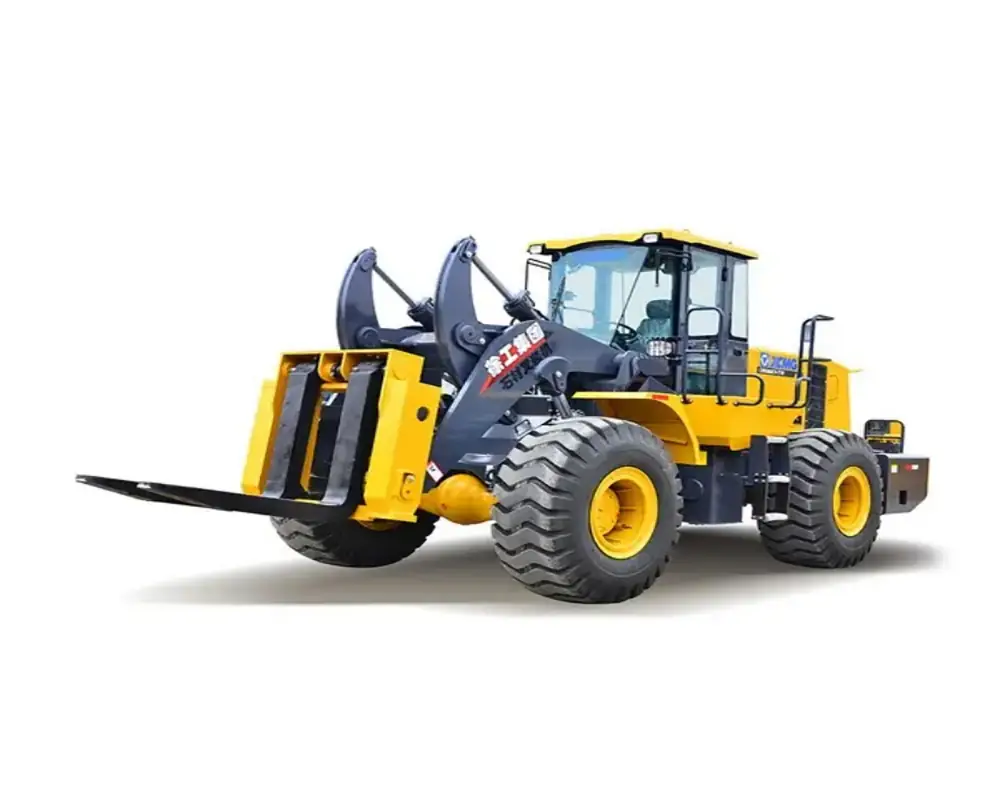
The XCMG wheel loader range includes the LW500KV-T18, listed as a dedicated stone fork loader for stone extraction and transfer. Its specifications should be compared with the buyer’s load sheet, site layout, and required lifting conditions.
Review the Key Specifications
The supplier’s product page lists the following figures:
| Specification | Value listed by the supplier |
| Rated load | 18,000 kg |
| Operating weight | 20,400 kg |
| Engine rated power | 162 kW |
| Maximum breakout force | 170 kN |
| Fork dumping height | 3,420 mm |
| Overall dimensions (L × W × H) | 8,630 × 2,850 × 3,500 mm |
Published specifications differ by source. XCMG Global lists an operating weight of 21,000 kg and rated power of 170 kW. The Chinese listing for the LW500KV(GIV)-T18 gives an operating weight of 21,900 kg and rated power of 170 kW.
Stone Handling for Heavy Blocks
XCMG’s Chinese product information states that the LW500KV(GIV)-T18 can handle loads up to 18 tonnes at lifting heights below 1.5 m. This rating applies to a defined operating condition, not every lifting height or block shape. Confirm the allowable load for the selected configuration.
Adjustable Fork Spacing
The manufacturer describes adjustable fork spacing for handling different types of stone. This can be useful when block widths vary. Ask for the adjustment range and verify the proposed fork positions against the dimensions of the blocks handled most frequently.
Lifting Height Options
XCMG’s Chinese product information lists a standard lifting height of 3,050 mm, an optional working linkage reaching 3,450 mm, and a high-position lifting capacity of 14 tonnes. Confirm which linkage is included in the quotation and the applicable capacity at the required height.
Structure and Hydraulic Protection
XCMG describes a longer wheelbase, wider track, and heavy counterweight, along with protective sleeves for hydraulic hoses and sealing arrangements at key hydraulic connections. These features are relevant to heavy stone work, but they do not replace capacity and site checks.
Ask the supplier to confirm which protective features are included in the delivered machine and follow the maintenance intervals in the technical documentation.
Frequently Asked Questions
What Is the Rated Load of the LW500KV-T18?
Published product information lists a rated load of 18,000 kg. XCMG’s Chinese product page states that loads up to 18 tonnes can be handled at lifting heights below 1.5 m. Confirm the applicable load limit and configuration in the current datasheet.
What Is the Operating Weight of the LW500KV-T18?
Published figures vary: the supplier lists 20,400 kg, XCMG Global lists 21,000 kg, and XCMG’s Chinese listing for the LW500KV(GIV)-T18 lists 21,900 kg. Ask the supplier to confirm the weight of the exact machine being quoted.
What Fork Configuration Is Available for the LW500KV-T18?
XCMG describes an adjustable fork arrangement. Confirm the available adjustment range and attachment configuration, and request a drawing based on the dimensions of the blocks you handle.
How Should Buyers Compare Loader Capacity?
Compare the heaviest planned load with the manufacturer’s allowable capacity for the intended attachment and lifting conditions. Check load position and lifting height, too. ISO 14397-1 provides methods for determining rated operating capacity and verifying calculated tipping load.
What Should an International Purchase Quotation Include?
The quotation should state the exact model, attachment configuration, agreed specifications, inspection requirements, delivery scope, warranty, and included documents. Freight, insurance, and other applicable charges should be itemized for accurate comparison.
Conclusion
The most suitable stone loader is not necessarily the machine with the highest headline capacity or the lowest purchase price. A better decision comes from matching the machine to the block dimensions, lifting position, site access, and handling frequency.
For stone yards, adjustable forks and lifting-height options can help accommodate different block sizes and storage arrangements. Maintenance access and spare-parts availability also deserve attention when equipment works around rough stone. Reviewing these details before purchase helps buyers plan for day-to-day operation and future maintenance, rather than focusing only on the initial quotation.
If you are sourcing a stone fork loader for your operation, provide the stone dimensions, maximum block weight, required lifting height, fork configuration, site layout, and operating conditions. CNFORCE can help confirm the suitable equipment configuration and provide a customized quotation.