Key Takeaways
- A container stacker is mainly used to move and stack empty containers in ports, terminals, logistics yards, and railway hubs.
- Before purchasing, define the container size, maximum actual container weight, and target stacking height. These figures help determine the required capacity, lifting range, spreader configuration, and yard space.
- An empty container handler is suitable when the main work involves storing and moving empty containers with multi-layer stacking. When loaded containers are also handled regularly, capacity must be checked against their actual weight.
- Aisle width, turning radius, and the container handling route need to match the machine’s operating dimensions.
Introduction
Choosing the right reach stacker for a container yard is not simply about finding a machine with a higher lifting capacity. For an empty-container application, the equipment should match the way containers are stored and moved. It also needs enough room to enter the stack area, turn, and reach the required lifting height.
For an empty-container application, start with three basic figures: container type, target stacking height, and maximum actual container weight. These figures help determine the required capacity, lifting range, and yard space.
Start by Defining the Main Handling Task
Before comparing machines, look at the work the yard performs every day. Empty-container storage is different from loaded-container handling, so the equipment should match the actual application.
Choose an Empty Container Handler for Empty-Container Storage
An empty container handler is designed to move and stack empty containers. A container stacker is suitable for yards where daily work includes receiving containers, moving them between storage areas, and building multi-layer stacks.
A container reach stacker may also be considered when the yard needs flexible handling of containers in different positions. However, the selection should still be based on the actual container weight, stacking height, and available operating space.
Loaded-container handling requires a different capacity check. The machine must handle the actual container weight at the required lifting height, and the relevant load chart needs to be reviewed.
For a yard focused on empty containers, define the required stacking height and maximum container weight first. When both empty and loaded containers are handled, base the capacity check on the heaviest container involved.
Match Stacking Height with Actual Load Requirements
Once the main handling task is clear, the next step is to define the stacking requirement. Container height and the number of layers determine how high the machine needs to lift, while container weight affects the required capacity at that height.
Set the Container Height and Target Stacking Layers First
Container height affects the lifting range required during stacking.
An 8’6″ container and a 9’6″ container do not require exactly the same lifting range when stacked to the same number of layers. The difference becomes more important as the stack gets higher.
A yard that stores both container heights should check the stacking requirement for each one. A single maximum stacking figure does not show whether the machine can handle the actual storage plan.
For example, the yard may require 8 layers for 8’6″ containers and 7 layers for 9’6″ containers. Ask the supplier to provide stacking data for both container heights.
Use the required number of layers as the purchasing reference. A higher advertised maximum is not automatically a better match for the yard.
Check Rated Capacity Against the Actual Container Weight
Stacking height is only part of the selection. The machine must also handle the heaviest container at the required lifting height.
Four figures should be checked:
- Maximum actual container weight
- Target stacking layers
- Load center
- Rated capacity at the required height
The HSE explains that the actual safe working capacity of an industrial truck depends on factors such as load distance and lifting height. The applicable capacity should be confirmed from the machine’s capacity plate or load chart.
Stability is another consideration in container handling. ISO 22915-12 specifies stability verification tests for industrial variable-reach trucks within its scope when they handle empty or laden freight containers of 6 m (20 ft) and longer.
When requesting a quotation, provide the actual container weight, load center, and required lifting height. Ask the supplier for the corresponding rated capacity. The maximum lifting capacity shown in a brochure alone does not confirm suitability.
Check Machine Dimensions Against the Yard Layout
A machine may have sufficient lifting capacity but still be difficult to operate in an existing yard. Aisles and turning areas can be difficult to change after the yard is built.
The machine needs room to approach the container, position itself, turn, and complete the pick-and-place movement. Check the operating route before finalizing the equipment model.
Aisle Width Determines Whether Containers Can Be Picked and Placed
The aisle must provide enough room for the machine to enter the stack area and position itself correctly.
When an aisle is too narrow, the machine may not reach or align with the container. More lifting capacity will not solve this space problem.
Measure the actual yard layout before purchasing. Check the aisles used for 20 ft containers and those used for 40 ft containers. Leave enough operating space near the stacks for the machine to approach and position the spreader.
Where both container sizes are handled, check each operating condition separately. One aisle width should not be assumed to suit every container type.
Check Turning Radius Along the Actual Operating Route
Turning space matters just as much as aisle width.
In a yard with parallel container rows, the machine may need to turn at the end of an aisle before entering another row. Overall length and width alone do not show whether this movement is possible.
The minimum turning radius gives a more useful reference. Compare it with the actual route from one operating area to another.
For a new yard, turning areas can be included in the layout from the beginning. An existing yard needs a site check. Measure aisle ends and other areas where the machine must change direction.
When turning space is limited, confirm the complete operating route before comparing machines on lifting performance.
Confirm the Spreader and Ground Conditions
Machine dimensions are only part of site compatibility. The selected spreader must match the containers, and the yard surface must support the equipment during repeated operations.
Match the Spreader to the Container Types
The spreader locks onto the container during lifting, so its configuration must match the container types handled in the yard.
Standard container operations require a compatible spreader. Different container lengths may require additional confirmation from the supplier.
The HSE notes that attachments can affect the stability and actual capacity of industrial trucks. The supplier or manufacturer should confirm that the selected attachment is suitable and whether the rated capacity needs to be adjusted.
For yards handling both 20 ft and 40 ft containers, confirm that the spreader supports both sizes. Check the rated capacity with the selected configuration as well.
Check Ground Conditions Before Selecting the Machine
The yard surface must support the machine, the container load, and repeated traffic.
Ground bearing capacity is one point to check. Surface condition and drainage also matter, especially in areas used for frequent container movement.
For an existing yard, inspect the main travel routes and container storage areas. Where the ground cannot support the combined machine and container loads, site improvements should be completed before the equipment is put into operation.
Use Workload to Compare Operating Efficiency
After the basic requirements are confirmed, daily workload becomes useful when comparing machines that already fit the application.
Travel speed is only one part of productivity. A complete container-handling cycle can include traveling to the container, positioning, locking the spreader, lifting, moving, placing, and returning.
As daily container volume increases, cycle time becomes more important. Lifting and lowering speed matter, while travel speed and operator controls can also affect handling time.
For a high-volume yard, ask suppliers for lifting, lowering, and travel data. Use the actual handling route to estimate the time required for one container.
In a smaller yard, capacity, stacking capability, and site compatibility may matter more than maximum speed. Compare operating speed after these basic requirements have been met.
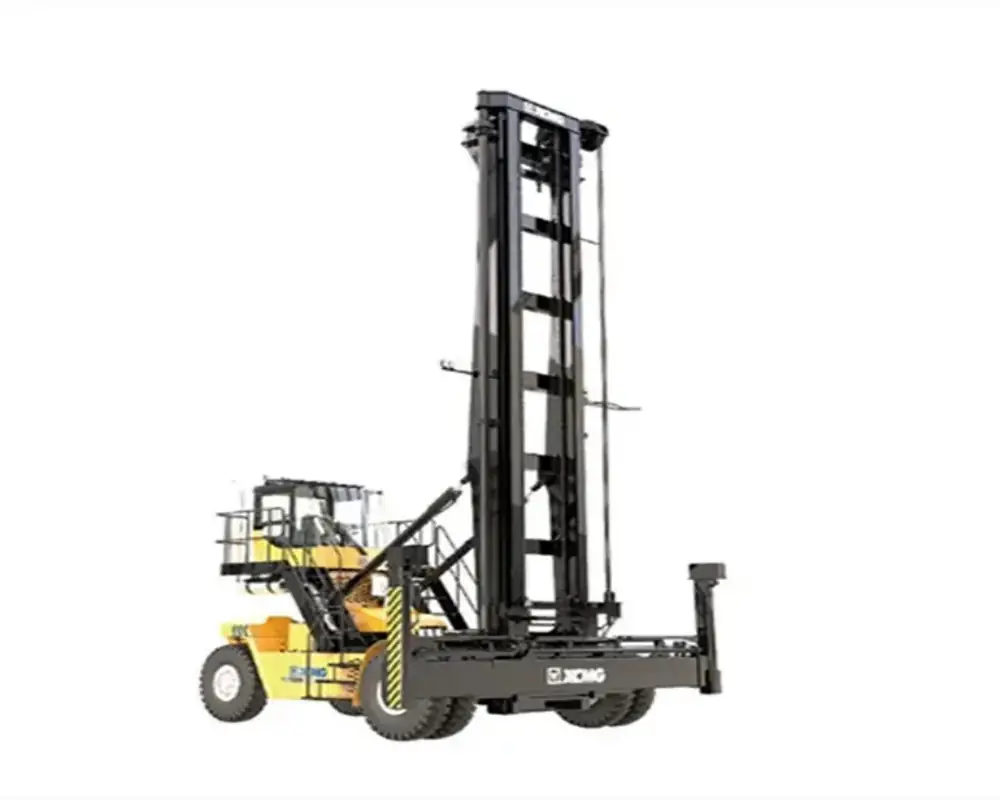
Why Choose XCMG XCH908K Empty Container Handler?
The previous sections covered stacking height, rated capacity, yard space, and workload. These criteria provide a useful basis for looking at a specific machine and its published specifications.
The XCMG XCH908K is designed for empty container handling and multi-layer stacking. According to the manufacturer’s information, it has a rated capacity of 9,000 kg, defined stacking capabilities for different container heights, and specified aisle width data for 20 ft and 40 ft container operations.
The XCH908K can also be evaluated when buyers are comparing an xcmg reach stacker with other container-handling equipment. The key point is to compare its published specifications with the actual requirements of the yard.
| Parameter | XCH908K |
| Rated capacity | 9,000 kg |
| Stacking capability | 8’6″: 8 layers; 9’6″: 7 layers |
| Aisle width | 20 ft: 10,000 mm; 40 ft: 14,000 mm |
| Overall weight | 41,900 kg |
| Minimum turning radius | 6,200 mm |
Defined Stacking Capability for Different Container Heights
The XCH908K can stack 8’6″ containers up to 8 layers and 9’6″ containers up to 7 layers.
These figures can be compared directly with the storage plan. A yard handling both container heights can check the required number of layers for each type before confirming the equipment.
Application Range in Ports and Logistics Yards
The XCH908K is intended for applications such as ports, terminals, border yards, logistics yards, and railway hubs.
Its configuration is designed for repeated container handling, where the machine needs to move between storage areas and complete frequent lifting and stacking operations.
For buyers working in different yard environments, compare the machine’s stacking capability and operating dimensions with the required storage height, traffic volume, and available space.
Specified Aisle Data for 20 ft and 40 ft Containers
The published aisle width is 10,000 mm for 20 ft container operations and 14,000 mm for 40 ft container operations.
These figures give buyers a direct reference when checking an existing yard. Measure the relevant aisles and compare them with the stated requirements. The turning area should be checked at the same time.
Engine and Drivetrain Options for Different Operating Environments
Cummins and Volvo engine options are available for the XCH908K. The machine uses a DANA transmission and Kessler axles.
The operating environment can help determine the suitable configuration. Local fuel availability is one factor. Maintenance resources and spare-parts supply are also important for long-term operation.
Hydraulic and Power Matching for Frequent Handling
The XCH908K uses a dual-pump hydraulic system, dual-pump flow merging technology, and dynamic power matching technology.
According to the manufacturer’s information, the power system adjusts engine operation according to hydraulic pressure and operating speed requirements. The machine also uses dynamic anti-rollover technology, which can limit travel and operating speeds according to operating conditions.
These configurations are relevant to repeated lifting, lowering, travel, and multi-layer stacking. When evaluating the machine, compare the configuration with the expected cycle time and daily container volume.
Frequently Asked Questions
How many layers can the XCH908K stack?
The XCH908K can stack 8’6″ containers up to 8 layers and 9’6″ containers up to 7 layers.
Can the XCH908K handle 20 ft and 40 ft containers?
The manufacturer’s specifications provide aisle width data for both 20 ft and 40 ft container operations: 10,000 mm and 14,000 mm respectively.
The actual yard layout should still be checked, including the turning space and route to the container stacks.
What is the rated capacity of the XCH908K?
The XCH908K has a rated capacity of 9,000 kg.
For actual equipment selection, also confirm the load center, required lifting height, and rated capacity under the required operating condition.
What is a container stacker used for?
A container stacker is used to move, lift, and stack containers in yards, terminals, logistics facilities, and other container-handling areas. The suitable configuration depends on container weight, stacking height, container size, and yard layout.
How should buyers compare a reach stacker container handler with a container stacker?
The comparison should focus on the actual work required in the yard. Check container weight, required stacking height, container sizes, aisle width, turning space, and daily workload.
For empty-container storage, the machine should be selected according to the required stacking and yard conditions rather than simply choosing a model with a higher maximum lifting capacity.
Conclusion
Selecting a container stacker for an empty-container yard requires more than checking maximum lifting capacity. The machine needs to match the container weight, stacking height, and available yard space.
The XCH908K provides defined stacking capabilities for 8’6″ and 9’6″ containers, along with specific aisle data for 20 ft and 40 ft container operations.
If you are sourcing an empty container handler for your yard, provide the container sizes, maximum container weight, required stacking height, aisle width, and operating conditions. CNFORCE can help confirm the suitable equipment configuration and provide a customized quotation.