Key Takeaways
- Match rated capacity to the actual load weight and working radius, not just the maximum tonnage shown in a brochure.
- Compare boom length, jib configuration, and required hook height before confirming a lifting plan.
- Check ground conditions, access width, turning space, and travel requirements before selecting a crane type.
- Review the load chart, hydraulic system, safety devices, and maintenance records before placing an order.
- Request the crane’s technical specifications and load chart to verify whether it can complete the planned lifts.
Introduction
Selecting a mobile crane for heavy-duty work involves more than comparing lifting capacities. A crane may have sufficient rated tonnage but still be unsuitable if it cannot reach the required working radius, access the jobsite, or operate safely on the available ground.
Buyers should assess the complete lifting task before comparing equipment. This includes the load weight, lifting height, working radius, ground conditions, travel route, and frequency of operation. These factors help determine which crane configuration is practical and whether its rated performance matches the site’s requirements.
Which Crane Type Fits Your Jobsite?
The first decision is whether the job requires a crane designed mainly for road travel or one intended to move around demanding work areas.
Rough-Terrain Crane vs. Truck Crane: What Is the Difference?
A conventional truck crane is generally designed for road mobility between jobsites. Its carrier is suited to traveling on public roads, while lifting operations normally require a suitable, prepared working surface.
A rough-terrain crane is designed for movement around construction sites and uneven working areas. Four-wheel drive and specialized steering arrangements can help it travel across rough ground and maneuver within restricted site areas.
The distinction affects how the crane should be selected:
- Road travel between separate locations is a major requirement: assess a road-going crane and its transport limitations.
- The crane must move around an uneven construction site: assess its drive system, ground clearance, and steering modes.
- The lifting position changes frequently within one site: consider whether the crane can travel between positions safely and efficiently.
Do not assume that a crane designed for rough terrain can travel freely with a suspended load. Any pick-and-carry operation must follow the manufacturer’s instructions and the applicable load chart. OSHA also requires operators to follow the manufacturer’s procedures and rated-capacity limitations.
When Is a Rough-Terrain Crane the Better Option?
A rough-terrain configuration is worth evaluating when the jobsite has unpaved access roads, compacted soil, uneven surfaces, or limited space for repositioning.
Before choosing one, inspect the route from the site entrance to the lifting area. Check for soft ground, slopes, drainage channels, overhead obstacles, and tight turns. A crane may have suitable off-road mobility but still be unable to reach the required position if the access route is too narrow or the turning area is insufficient.
Ground support is equally important. The setup area must be firm, drained, and graded sufficiently to meet the manufacturer’s requirements. Where necessary, suitable mats or other support measures should be used. Underground utilities, pits, and other hidden hazards must also be identified before setup.
How Should You Check Lifting Capacity and Boom Reach?
Once the crane type is clear, the next step is to verify whether it can complete the planned lift at the required position.
Why Does Working Radius Matter More Than Headline Tonnage?
Maximum rated capacity is not the same as lifting capacity at every working position. A crane’s allowable load generally changes with boom length, working radius, boom angle, and lifting configuration.
For example, a crane rated for a heavy load at a short radius may have a much lower allowable capacity when the load is farther from the center of rotation. Buyers should therefore verify the load chart rather than relying on the headline tonnage.
Use this sequence when checking a lifting plan:
- Confirm the total suspended weight, including the hook block, lifting beam, slings, and other accessories.
- Measure the working radius from the crane’s center of rotation to the load’s vertical lifting line. Do not measure from the edge of the chassis or tires.
- Identify the required boom length, boom angle, lifting direction, and any jib configuration.
- Find the matching operating condition in the manufacturer’s load chart and confirm that the rated capacity exceeds the total suspended load.
If the chart does not provide sufficient capacity, the lifting plan must change. Possible adjustments include moving the crane closer, changing the lifting position, using a different boom arrangement, or selecting a crane with greater capacity at the required radius. Never treat the maximum rated capacity as a universal lifting limit.
How Do Boom Length and Jib Options Affect the Lift?
Boom length determines how the crane reaches the required height and horizontal position. However, a longer boom does not automatically provide greater lifting capacity. As boom extension increases, allowable capacity may decrease, depending on the operating radius and configuration.
A jib can extend hook height or provide additional reach when the main boom alone cannot meet the lifting requirement. Buyers should check whether the jib is compatible with the planned boom arrangement and whether its load chart covers the intended operating condition.
Before confirming the configuration, establish three measurements: the required hook height, the horizontal distance from the crane’s center of rotation to the load, and the clearance needed to pass over nearby structures. These measurements help identify whether the main boom is sufficient or a jib is necessary.
For a telescopic truck crane, buyers should also review the boom extension sequence and the capacity available at each relevant boom length. The final configuration must be checked against the corresponding load chart, not estimated from the maximum boom length alone.
Which Operating and Safety Features Should Buyers Evaluate?
Lifting capacity and reach establish whether a crane can perform the task. Mobility, hydraulic control, and safety systems determine how effectively the work can be carried out.
How Do Drive and Steering Systems Affect Site Mobility?
Drive configuration affects traction, while steering configuration affects maneuverability. These features should be evaluated against the actual site route rather than treated as general equipment advantages.
Measure the narrowest access point and the tightest turning area. Compare the available width with the crane’s transport width, then check the minimum turning radius against the site’s corners and work lanes. If the route includes sharp turns, ask whether alternative steering modes can help the crane maneuver without entering unsafe ground.
Also check the maximum gradeability against the site’s slopes. This figure does not mean the crane can safely travel on every slope under every load condition. Follow the manufacturer’s travel instructions and operating limits.
What Should You Check in the Hydraulic System?
The hydraulic system controls boom extension, lifting, luffing, and other crane movements. Buyers should evaluate both the system’s technical configuration and its condition during operation.
When reviewing a truck crane hydraulic system, ask the supplier for details about the pump arrangement, hydraulic circuit, recommended oil grade, filter specifications, and maintenance intervals. These details help establish whether the system is suitable for the expected workload and service environment.
During an operational inspection, observe whether controls respond smoothly to small inputs. Unexpected pauses, jerky movements, oil leaks, damaged hoses, abnormal noise, or overheating may indicate problems that require further inspection. Ask for maintenance records and clarify which hydraulic components are covered by the supplier’s after-sales support.
Which Safety Documents and Devices Are Essential?
The load chart and operating manual are essential documents, not optional reference materials. They should match the crane’s actual configuration and explain the permitted operating conditions.
Buyers should also confirm the availability and function of the load moment indicator (LMI), overload warning devices, operating alarms, and other safety equipment specified by the manufacturer. The operator must be able to identify the applicable load chart and verify the load weight before lifting.
A complete pre-purchase review should include the technical specification sheet, load charts, operation and maintenance manuals, inspection records, and a clear explanation of the safety devices supplied with the crane.
What Should Buyers Verify Before Ordering?
After the technical requirements have been established, buyers should confirm that the crane can be delivered, deployed, and supported at the destination.
Can the Crane Reach the Site and Be Deployed Efficiently?
Check the transport dimensions, total weight, delivery route, site entrance, and available unloading area. Bridges, overhead structures, narrow gates, and road restrictions may affect transportation even when the crane can operate successfully once it reaches the site.
For projects involving repeated lifting positions, estimate how often the crane will need to move and whether the site layout allows safe repositioning. This helps buyers assess practical working efficiency instead of focusing only on lifting performance.
Which Documents and Supplier Services Should Be Confirmed?
Before ordering, confirm the technical configuration, load chart, delivery scope, spare-parts availability, warranty terms, and commissioning arrangements. Buyers importing equipment should also clarify the shipping documents and any destination-specific import requirements.
Ask the supplier to confirm which technical documents will be provided and whether technical consultation, spare-parts support, and maintenance guidance are available after delivery. These details can affect equipment uptime and long-term operating costs.
Why Choose CNFORCE for the XCMG XCR120 Rough-Terrain Crane?
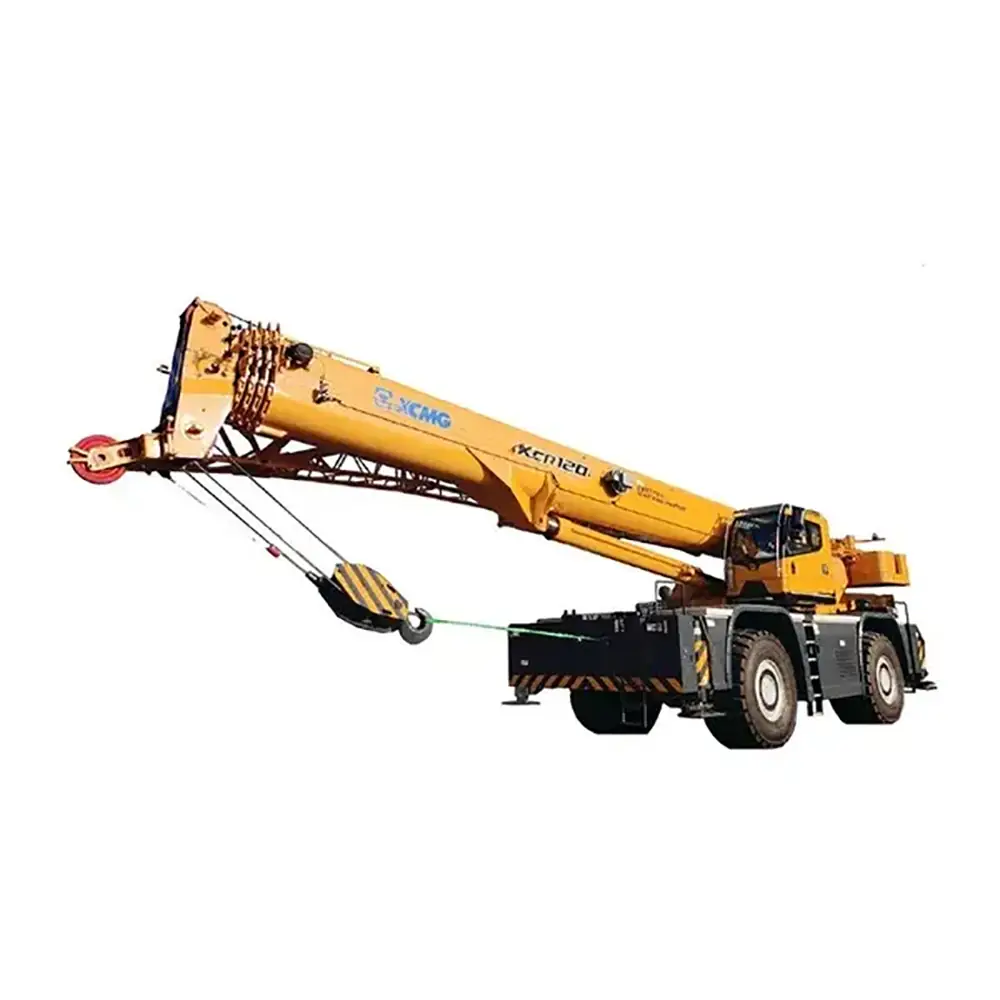
For buyers evaluating an XCMG truck crane for off-road lifting, it is important to distinguish a rough-terrain crane from a conventional road-going truck-mounted model. The XCMG XCR120 is designed for rough-terrain applications, with four-wheel drive and steering for movement around demanding jobsites.
| Specification | XCR120 |
| Maximum rated lifting capacity | 120 t |
| Main boom length | 13.5–48 m |
| Jib length | 11.4 m / 20.6 m |
| Maximum lifting height | 49.1 m with main boom / 69.2 m with jib |
| Engine | Cummins QSL8.9, 242 kW |
| Drive and steering | 4×4 drive / 4×4 steering |
Lifting Capacity for Heavy Industrial Tasks
The XCR120 has a maximum rated lifting capacity of 120 t. This rating provides a starting point for evaluating heavy lifting requirements, but the actual allowable load must be checked against the working radius, boom configuration, and corresponding load chart.
For procurement, buyers should submit their typical load weights and lifting radii to confirm whether the crane is suitable for their regular operations.
Boom and Jib Configurations for Different Hook Heights
The five-section main boom extends from 13.5 m to 48 m. The crane can also be configured with an 11.4 m or 20.6 m jib. Its maximum lifting height reaches 49.1 m with the main boom and 69.2 m with the jib.
This range gives buyers options for different hook-height requirements. The final selection should still be verified against the load chart and the clearance available at the jobsite.
Steering Options for Restricted Work Areas
The crane features 4×4 drive and steering, with front-wheel, rear-wheel, four-wheel, and crab-walk steering modes. These options support maneuvering in different site layouts.
Its minimum turning radius is 9.5 m. Buyers should compare this figure with the actual turning space available at the site before confirming access and deployment plans.
Hydraulic Control and Operator Support
The XCR120 uses a dual-pump variable-displacement hydraulic system and is equipped with a Hirschmann load moment indicator. The operator cab can tilt from 0° to 20°, supporting visibility adjustments during operation.
CNFORCE can provide technical consultation, genuine spare-parts support, logistics coordination, and assistance with import and deployment documentation. Buyers should confirm the required configuration and support scope before placing an order.
Frequently Asked Questions
Does the XCR120 reach a lifting height of 69.2 m with its main boom?
No. Its maximum lifting height is 49.1 m with the main boom. The maximum height of 69.2 m is achieved with the jib configuration.
Can the XCR120 travel with a suspended load?
The crane has pick-and-carry capability, but travel with a load must follow the manufacturer’s instructions and the applicable load chart. Buyers should confirm the permitted load, travel path, ground conditions, and operating configuration before planning this type of movement.
Is a 120-ton crane able to lift 120 tons at every working radius?
No. The 120 t figure is the maximum rated lifting capacity under specified conditions. The allowable load changes with working radius, boom length, and lifting configuration. Always check the relevant load chart.
What information should buyers provide when requesting a crane quotation?
Provide the maximum and typical load weights, working radius, required hook height, site ground conditions, access limitations, expected working frequency, and destination. These details help the supplier assess the appropriate configuration and prepare relevant technical information.
What ground conditions should be checked before crane setup?
Check ground firmness, drainage, slope, levelness, and underground hazards. The ground must meet the manufacturer’s requirements for the planned crane configuration. Suitable mats or other support measures may be necessary where ground bearing capacity is insufficient.
Conclusion
A suitable rough-terrain crane should match the complete lifting task, not just the maximum load stated in its specifications. Working radius, hook height, ground conditions, maneuverability, and safety documentation all affect whether the equipment can perform reliably at the jobsite.
If you are sourcing a rough-terrain crane for infrastructure construction or industrial lifting, send CNFORCE your load weight, working radius, required hook height, site ground conditions, boom or jib requirements, and destination details. The team can help review the configuration and provide technical specifications, the relevant load chart, and a quotation.