Key Takeaways
- Match the machine’s working width and milling depth to the pavement section and treatment area.
- Evaluate engine power, cutter spacing, rotor configuration, and working speed together rather than relying on one specification.
- Check depth control, liquid injection, drive, and steering functions against the materials and conditions on site.
- Select equipment according to the required recycling process, expected output, and maintenance conditions.
Introduction
Road rehabilitation projects vary in pavement structure, material condition, and treatment depth. Choosing the right Cold Recycler requires more than checking engine power or maximum working capacity. Buyers need to understand the intended treatment, compare the machine’s technical specifications with site requirements, and confirm that its operating features support the planned construction process.
What Should Buyers Consider Before Choosing a Cold Recycler?
The first step is to define the work the equipment will perform. Asphalt pavement recycling and soil stabilization involve different materials and treatment objectives, so the machine must match the actual construction method.
Type of Road Rehabilitation Work
A road cold recycler is commonly used for in-place pavement rehabilitation. It mills existing asphalt pavement, reduces the material to a workable size, and mixes it with a suitable recycling agent when required. This process can help reuse existing pavement materials instead of removing the entire road structure.
Before selecting equipment, identify the treatment area and the pavement layers involved. Check whether the project requires recycling an asphalt layer, treating a bound base, or improving an unbound road base. These tasks may require different milling depths, mixing conditions, and material controls.
For example, a project that only needs to process a surface asphalt layer does not necessarily require the same working depth as one involving deeper pavement rehabilitation. The treatment plan should therefore be established before comparing machine specifications.
Difference Between Cold Recycling and Soil Stabilization
A cold recycler and soil stabilizer may share milling and mixing functions, but their main applications are different.
Cold recycling generally processes existing asphalt pavement or reclaimed road materials. Soil stabilization focuses on improving the engineering properties of soil or granular materials by mixing them with additives such as cement or lime.
The distinction affects the required working depth, mixing uniformity, additive delivery, and final material properties. Buyers should identify the material to be treated and the required outcome before deciding whether one machine can cover both applications.
If a project involves both pavement recycling and soil stabilization, check whether the machine’s rotor, cutting tools, and material injection system are suitable for the two processes. Do not assume that equipment designed for one application will automatically deliver the required results in the other.
Site Conditions and Material Assessment
Site conditions determine whether the machine can work efficiently. Start with pavement investigation. Core samples and existing construction records can help establish layer thickness, material composition, and the condition of the road base.
Also consider road width, turning space, access restrictions, and the availability of water or recycling agents. Hard or uneven materials may increase cutting resistance, while restricted working space can affect machine movement and construction efficiency.
A practical selection rule is to compare the required treatment depth with the machine’s rated maximum depth. If the project requires deeper treatment than the equipment can provide, the machine is unsuitable for that work. If its working width is narrower than the treatment area, more passes will be needed.
Which Technical Specifications Matter Most When Selecting a Cold Recycler?
Technical specifications should be assessed as a group. Working width, milling depth, engine power, cutter configuration, and operating speed affect one another and determine whether the equipment can meet the project’s production requirements.
Working Width and Milling Depth
Working width determines how much pavement the machine can process in one pass. A wider working width can reduce the number of passes on a broad road section. However, it should also match the available working space and the width of the treatment area.
Milling depth determines how much of the existing pavement or base material can be processed. Check the actual layer thickness and the required treatment depth before comparing this specification.
Maximum depth is a capacity limit, not necessarily the best depth for continuous operation. Material strength, pavement condition, and the required mixing quality can affect practical performance. If the target depth is close to the machine’s maximum capacity, confirm the expected operating conditions through a technical demonstration or comparable project records.
Engine Power and Operating Load
Engine power affects the machine’s ability to drive the rotor and process resistant materials. However, power alone does not determine production capacity.
The operating load also depends on milling depth, working width, material density, cutting resistance, and working speed. A machine may have sufficient rated power but still need to reduce its working speed when processing hard or uneven pavement.
When evaluating a cold recycler machine, consider engine power alongside operating weight, working width, maximum depth, and the material conditions expected on site. Comparable project records can help buyers understand how the machine performs under similar working conditions.
Cutter Spacing and Rotor Configuration
Cutter spacing and rotor configuration influence how the existing pavement is broken down and mixed. The required material gradation should guide the selection of cutting tools and rotor arrangements.
Buyers should check the recommended cutter type for the project material, the expected particle size after milling, and the availability of replacement teeth. Cutting tools are wear parts. Their service life depends on material hardness, abrasive content, working depth, and maintenance practices.
A machine that can reach the required depth may still be unsuitable if its cutting configuration cannot produce the material consistency required by the project. The expected gradation and mixing result should therefore be included in the technical evaluation.
Working Speed and Travel Speed
Working speed and travel speed serve different purposes. Working speed refers to movement while milling and mixing. It directly affects material processing and construction output. Travel speed refers to movement between work areas or during relocation.
Actual working speed depends on pavement strength, treatment depth, rotor load, and the required mixing quality. Increasing speed may improve the area covered per hour, but excessive speed can reduce processing quality if the material is not milled and mixed adequately.
For production estimates, use working speed rather than travel speed. A realistic estimate should also account for turning, overlapping passes, material supply, and routine stops.
Which Operating Features Should Buyers Check?
Beyond the main specifications, operating features affect construction consistency and the machine’s ability to handle different site conditions. Focus on functions that directly influence treatment quality and maneuverability.
Liquid Injection and Depth Control
Liquid injection is important when the recycling process requires water, emulsion, or another specified agent. The delivery system should distribute the liquid evenly across the working width and maintain the required addition rate as operating conditions change.
Depth control helps maintain a consistent treatment layer. Uneven depth can lead to inconsistent material processing and differences in the finished road structure.
During a demonstration, observe whether the injection system responds to changes in working speed and whether the operator can monitor the delivery process. Also check nozzle accessibility and cleaning requirements, since blocked or poorly maintained nozzles can affect liquid distribution.
Drive and Steering Modes
Drive and steering configurations influence traction and maneuverability. All-wheel drive can support movement under demanding site conditions, while different steering modes can help the machine operate in restricted areas or reposition between working sections.
Consider the road width, ground condition, turning space, and site layout. A machine intended for long highway sections may face different maneuverability requirements from one working on municipal roads or confined construction areas.
A practical site demonstration is useful when access is restricted. Check turning behavior, movement near road edges, and the operator’s ability to align the machine for the next pass.
Why Choose the XCMG XLZ2303S Cold Recycler for Road Rehabilitation?
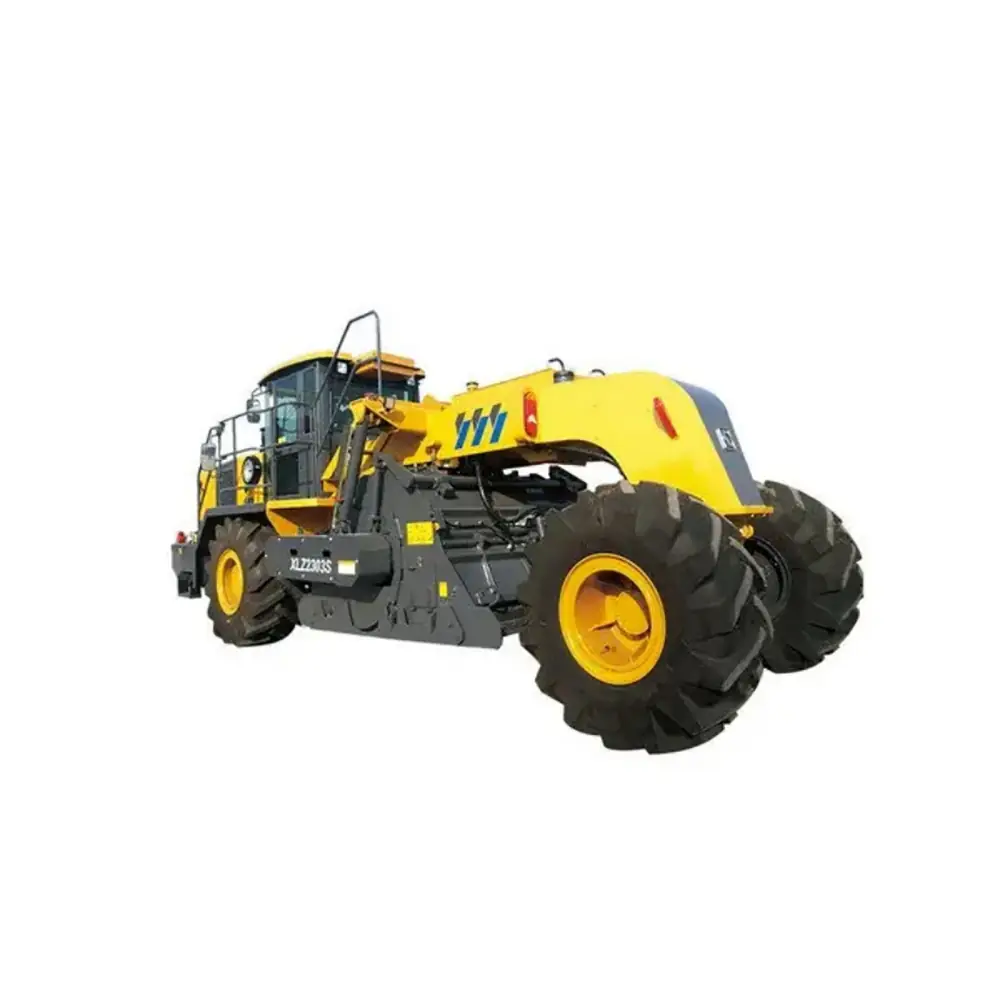
The XCMG XLZ2303S is designed for road milling, material processing, and mixing operations. Its technical specifications can be assessed against projects involving asphalt pavement recycling and suitable soil or base stabilization work.
Main Technical Specifications
| Item | Specification |
| Operating Weight | 26,500 kg |
| Engine Model | Weichai WP13G530E310 |
| Engine Rated Power | 390 kW |
| Engine Rated Speed | 1,900 rpm |
| Milling / Working Width | 2,300 mm |
| Maximum Milling / Working Depth | 400 mm |
| Cutter Spacing | 18 mm |
| Working Speed | 0–3.0 km/h |
| Travel Speed | 0–12.0 km/h |
| Drive | All-wheel drive |
| Steering Modes | Front-wheel, four-wheel, and crab-walk |
Suitable for Asphalt Pavement Rehabilitation
With a working width of 2,300 mm and a maximum milling depth of 400 mm, the XLZ2303S can be evaluated for projects that require in-place processing of existing asphalt pavement. Buyers should compare these limits with the actual pavement structure and the depth specified in the rehabilitation plan.
The required cutting depth and material condition will affect the practical working speed. A site assessment is still necessary before confirming the machine’s suitability for a particular road section.
Supports Road Base and Soil Stabilization Work
The machine can also be considered for suitable road base and soil mixing applications. Projects using cement, lime, or other specified additives require attention to material properties, additive distribution, and mixing uniformity.
Before using the machine for these tasks, confirm that the selected cutting tools and liquid or additive delivery arrangement match the construction method. The final mix design and site testing should determine whether the treated material meets project requirements.
Multiple Steering Modes for Different Site Conditions
The machine provides front-wheel, four-wheel, and crab-walk steering modes. These options give operators different ways to maneuver according to the working area and site layout.
For long, relatively open road sections, conventional steering may be sufficient. Four-wheel or crab-walk steering can be useful when the machine needs to reposition or work within more restricted areas. Buyers should assess these functions under actual site conditions rather than relying only on the listed modes.
Power and Maintenance Considerations
The machine is equipped with a 390 kW engine. This power rating should be considered together with the operating weight, rotor load, material resistance, and required treatment depth.
For long-term operation, maintenance planning should cover cutting teeth, rotor components, injection nozzles, filters, and other routine service items. Buyers should also review the operating manual and maintenance schedule to understand inspection intervals and replacement requirements.
Frequently Asked Questions About Cold Recyclers
What is the maximum milling depth of the XCMG XLZ2303S?
The listed maximum milling or working depth of the XCMG XLZ2303S is 400 mm. Actual working depth depends on pavement structure, material condition, and construction requirements.
What is the working width of the XCMG XLZ2303S?
Its listed milling or working width is 2,300 mm. This specification helps determine how many passes may be required to cover the planned treatment area.
What steering modes are available on the XCMG XLZ2303S?
The machine provides front-wheel steering, four-wheel steering, and crab-walk steering. These modes support different maneuvering requirements across open and restricted work areas.
Can an Asphalt Recycling Machine also be used for soil stabilization?
Some machines can support both applications, but suitability depends on the rotor, cutting tools, material properties, and additive delivery arrangement. Buyers should confirm that the machine configuration matches the intended soil stabilization process.
What affects the selection of a cold recycling machine?
The main factors include pavement structure, material type, treatment width and depth, required output, site access, and the recycling or stabilization method. These details should be defined before comparing machine specifications.
Conclusion
Choosing the right road recycling equipment requires matching its working capacity with the pavement structure, material conditions, and construction objectives. Working width, milling depth, engine power, cutter configuration, and operating functions should be evaluated together rather than as isolated specifications.
For projects considering the XCMG XLZ2303S, its 2,300 mm working width, maximum 400 mm milling depth, and multiple steering modes provide key specifications for technical evaluation. Buyers should compare these capabilities with actual site requirements before making a decision.
Contact the supplier to request a detailed specification sheet, machine configuration, and quotation. Providing information about pavement materials, treatment depth, and project conditions will help the supplier recommend a suitable configuration.